Intro (short summary)
John Bauer was a Swedish illustrator and painter whose images helped define how many people picture Nordic fairy tales today: deep forests, quiet lakes, trolls with human emotion, and small figures moving through vast nature. He is best known for his illustrations for Bland tomtar och troll (Among Gnomes and Trolls), a classic anthology of Swedish folklore.
-
John Bauer Humpe i Skogen Poster – Premium Art Print in 4 Sizes
Regular price From 184,00 DKKRegular priceSale price From 184,00 DKK -
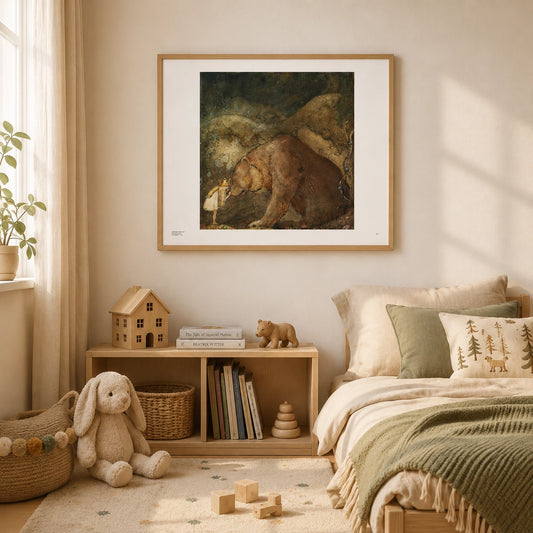
John Bauer The Princess and the Trolls Poster – Premium Quality Art Print
Regular price From 184,00 DKKRegular priceSale price From 184,00 DKK -
John Bauer Poster - 'Poor Little Basse!' (1912) – Premium Quality Art Print
Regular price From 184,00 DKKRegular priceSale price From 184,00 DKK
Collection: John Bauer (1882–1918)
Why John Bauer still draws people in
Bauer’s art feels like Scandinavian nature turned into story. His forests are not “backgrounds” — they are living spaces filled with moss, mushrooms, and shadowed light. That’s part of why his work is so loved as Nordic wall art: it brings mood, silence, and imagination into a room without needing loud colour.
He trained at the Royal Swedish Academy of Arts in Stockholm, but his lasting legacy is the visual world he created for folklore: trolls that can be gentle or unsettling, princesses that feel thoughtful rather than decorative, and a nature that looks real even when the creatures aren’t.
John Bauer in brief (life and work)
- 1882: Born in Jönköping, Sweden.
- Studied at the Royal Swedish Academy of Arts (Stockholm).
- Became famous for early editions of Bland tomtar och troll (Among Gnomes and Trolls).
- Worked with both illustration and painting, often mixing myth, landscape, and character-driven storytelling.
- 1918: Died at age 36 in a shipwreck on Lake Vättern, together with his wife (the artist Ester Ellqvist) and their young son.
Quote
“Although [Bauer] only mumbled about and never said clearly, he believed that all the creatures he drew actually existed.”
Source: Ove Eklund (friend of John Bauer), quoted in the biography summary on Wikipedia (referring to a 1953 article).
What to notice in a John Bauer artwork
The forest as character
Look for the way trees, rocks, and undergrowth shape the story’s emotion — safety, mystery, or quiet awe.
Trolls with personality
Bauer’s trolls are rarely “monsters only.” They can look tired, curious, proud, or oddly kind — which makes them feel real.
- English title commonly used: Humpe in the Woods
- (Often connected to Bauer’s fairy-tale illustration world and published context around Bland tomtar och troll.
- Swedish title: Stackars lilla Basse!
The Princess and the Trolls (1913)
- Swedish title: Prinsessan och trollen (En kväll vid midsommartid gingo de med Bianca Maria djupt in i skogen)
Fairy-tale minimalism
Many scenes use large dark spaces and simple shapes so your eye lands on one key moment: a gaze, a pause, a meeting in the woods.
FAQ
Are these printed locally?
Yes—on demand and near you in 20+ countries, reducing waste and CO₂.
What paper do you use?
Matte, museum-grade paper (200 gsm, ~10.3 mil), FSC-certified or equivalent for a refined, non-reflective finish.
Are these original artworks?
We curate Scandinavian masterpieces and prepare them for high-fidelity printing with careful restoration.
Do you offer multiple sizes?
Yes—our Denmark posters are available in several popular sizes. See each product page for options.