


Buy more and get free shipping
Peter Nicolai Arbo: The Battle of Stamford Bridge (1870)
Peter Nicolai Arbo: The Battle of Stamford Bridge (1870)
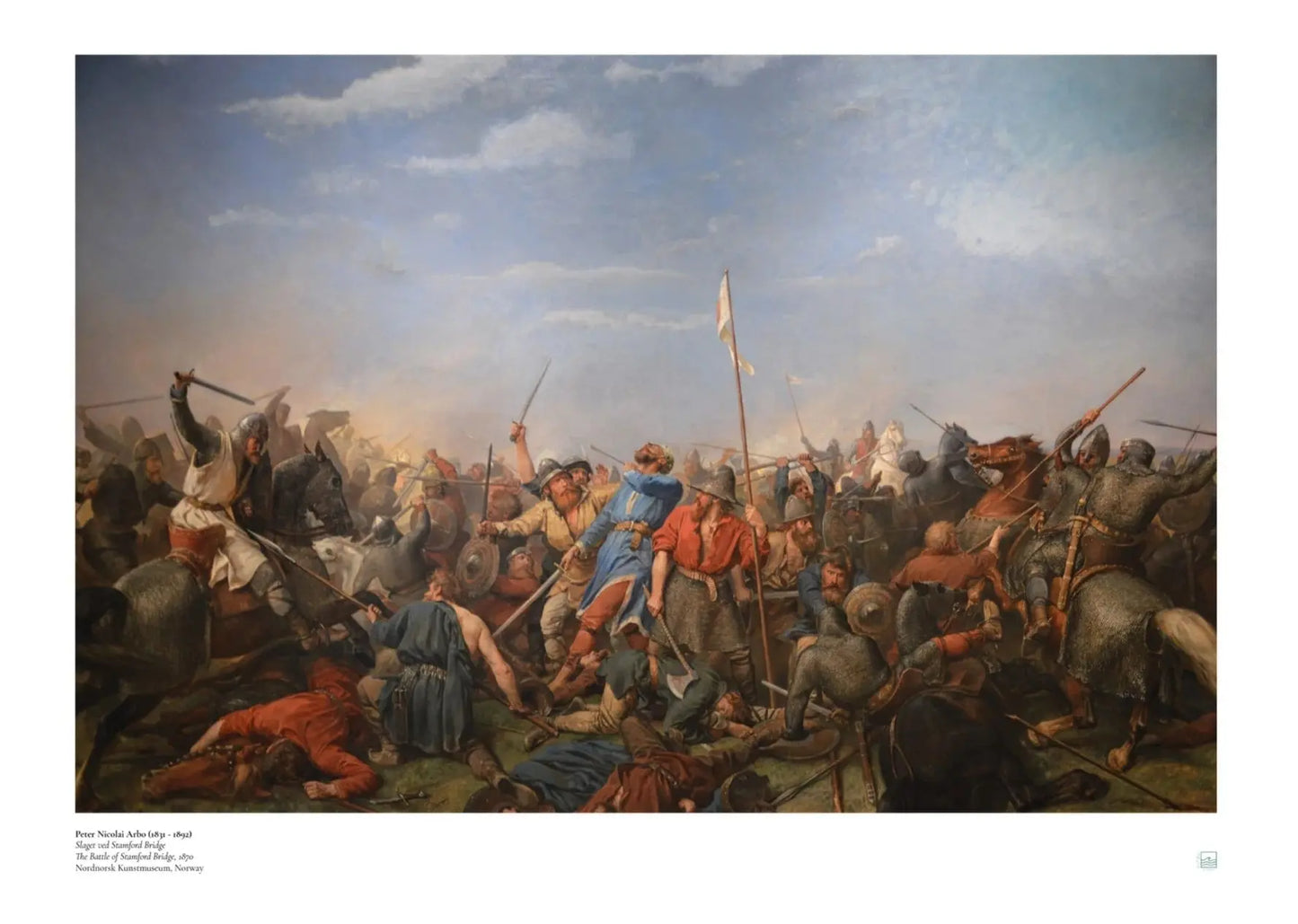
A dramatic Norwegian art poster featuring Peter Nicolai Arbo’s The Battle of Stamford Bridge from 1870. Warriors, horses and raised weapons fill the scene as the Norwegian king Harald Hardrada meets his final battle in England.
Couldn't load pickup availability
Secure and trusted checkout
Your payment information is processed securely. We do not store payment details nor have access to your payment information.
- Locally produced
- Easy Returns
- Quality Guarantee
Details
Details
A dramatic Norwegian art poster featuring Peter Nicolai Arbo’s The Battle of Stamford Bridge from 1870. Warriors, horses and raised weapons fill the scene as the Norwegian king Harald Hardrada meets his final battle in England.
Printed locally on heavyweight matte paper, as close to you as possible. Typical delivery time: 2–5 business days.
- Norwegian history painting by Peter Nicolai Arbo
- Depicts the Battle of Stamford Bridge in 1066
- Created in 1870
- Dramatic scene with warriors and horses
- Printed on 200 gsm matte quality paper
- Available in five sizes
- Frame not included
The fall of Harald Hardrada
Arbo places the Norwegian king at the centre of a dense and turbulent battlefield. Mounted warriors, shields, spears and struggling horses create a sweeping movement across the composition. The scene refers to the death of Harald Hardrada during the battle on 25 September 1066.
The painting does not attempt to document every detail of medieval warfare. Arbo shaped the event as a monumental history painting, using gesture, movement and the clash of bodies to turn a distant episode into a dramatic national story.
A turning point in 1066
Harald Hardrada invaded England with an army supported by Tostig Godwinson, the exiled brother of the English king Harold Godwinson. After a Norwegian victory near York, the invaders were surprised by Harold’s rapidly advancing English army at Stamford Bridge.
Harald Hardrada and Tostig were killed, and the Norwegian force was defeated. The battle is often treated as the end of the Viking Age in England. Only weeks later, Harold Godwinson faced William of Normandy at Hastings. Read the historical account from the Viking Ship Museum.
“Peter Nicolai Arbo became our most important history painter.”
Arbo and Norwegian history painting
Peter Nicolai Arbo was born in Drammen in 1831 and trained in Copenhagen and Düsseldorf. He specialised in large narrative paintings inspired by Norwegian medieval history, sagas and Norse mythology. Horses became a recurring strength in his work, lending speed and physical force to his battle scenes.
The Battle of Stamford Bridge was completed in 1870 and is described by Norsk biografisk leksikon as Arbo’s last major history painting. The work combines his interest in medieval Norway with the theatrical composition associated with the Düsseldorf school.
Artwork details
| Artist | Peter Nicolai Arbo (1831–1892) |
|---|---|
| Norwegian title | Slaget ved Stamford Bridge |
| English title | The Battle of Stamford Bridge |
| Date | 1870 |
| Original medium | Oil on canvas |
| Subject | The death of Harald Hardrada at Stamford Bridge in 1066 |
| Genre | Norwegian history painting |
| Artistic context | Düsseldorf school and National Romanticism |
| Poster material | 200 gsm matte quality paper |
| Frame | Not included |
Available sizes
| Centimetres | Inches |
|---|---|
| 30 × 40 cm | 12 × 16″ |
| 40 × 50 cm | 16 × 20″ |
| 50 × 70 cm | 20 × 28″ |
| 60 × 90 cm | 24 × 36″ |
| 70 × 100 cm | 28 × 40″ |
Viking Age history for the home
The earthy colours, rushing horses and tightly packed figures give this poster a strong presence. It suits a study, library, hallway or living room where historical art can carry visual weight without relying on modern graphic effects.
Pair it with historic maps, Norse subjects or other works from our collection of Norwegian art.
Frequently asked questions
What does the painting depict?
It depicts the Battle of Stamford Bridge, where the Norwegian king Harald Hardrada was defeated and killed by the English army of Harold Godwinson on 25 September 1066.
Why is the battle associated with the end of the Viking Age?
The defeat ended Harald Hardrada’s attempt to conquer England and is often used as a symbolic endpoint for the Viking Age in England.
Who painted The Battle of Stamford Bridge?
Peter Nicolai Arbo, a Norwegian painter known for dramatic scenes from medieval history and Norse mythology, created the work in 1870.
Was the battle before or after Hastings?
Stamford Bridge took place on 25 September 1066. The Battle of Hastings followed on 14 October of the same year.
What paper is the poster printed on?
It is printed on heavyweight 200 gsm matte quality paper with a smooth, non-reflective surface.
Is a frame included?
No. The poster is supplied without a frame, allowing you to choose one that suits the artwork and your interior.
Meta — Best of Hygge by Scandinavia · Most Popular · New Arrivals · Norse Mythology & Viking Legends — Art Prints · Norway - Norwegian Art Prints





Don't forget your discount
Buy 2 posters and get the 3rd at 50% off.
The discount applies to the lowest-priced poster and is automatically deducted at checkout.
Join our Scandi Club and get 10% off your order.
Sign up and enjoy your member discount.


 Verified
Excellent quality
My print arrived quickly. The ink and paper quality was exceptional. I highly recommend these prints.
Verified
Very happy
I'm very happy with my beautifull print. Good quality of paper and bright colours. Delivering went smooth and fast. Very helpfull people.
Verified
Clear and beautiful picture
The print was clear and beautifully produced. Ordering was quick, and everything was as expected.

Local production helps reduce shipping distance and emissions.
- We only print when you order, using FSC-certified or equivalent matte paper (200 gsm, 0.26 mm) for a refined, non-reflective finish.
- Created on request - near you.

Compare size
How is your poster going to look on your wall?
- Choosing a selection results in a full page refresh.
- Opens in a new window.